
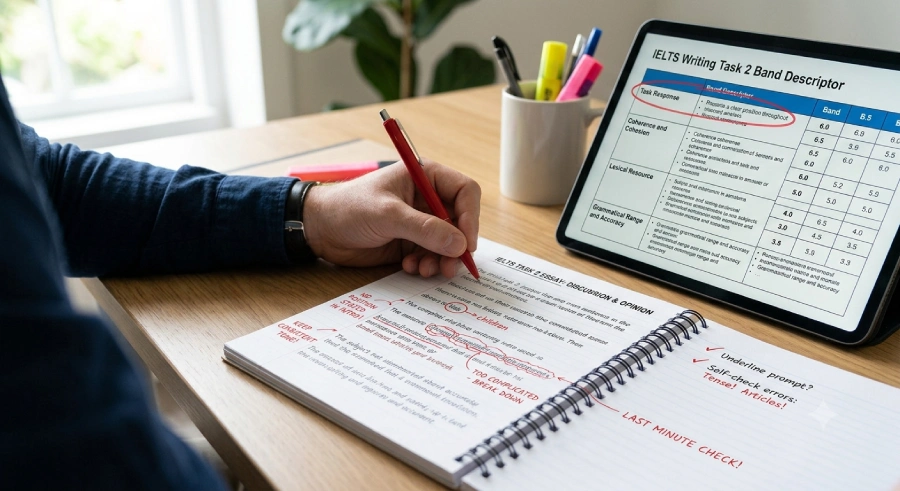
If you have taken the IELTS Writing test before and walked away with a lower band than expected, you are not alone. Most learners who plateau at Band 6 or 6.5 are not lacking ideas or intelligence. They are losing marks to a small set of repeatable mistakes that show up in essay after essay.
The good news is that once you know what these mistakes are, they are straightforward to fix. Here are the ones we see most often among our students at SpeakWell, and what to do instead.
1. Not answering the actual question
This is the single most damaging mistake in Task 2, and it has nothing to do with grammar. Many candidates read the topic quickly, recognise a familiar theme, and start writing a memorised essay structure without checking what the question is really asking.
If a prompt asks you to discuss the causes of a problem and suggest solutions, an essay that only talks about causes has not done the job, no matter how well it is written. If a question asks you to discuss both views and give your own opinion, ignoring your own opinion will cost you marks under Task Response, which makes up a quarter of your score.
Fix: Before you write a single sentence, underline every part of the question. Ask yourself what exactly you are being asked to do, and make sure your essay plan covers all of it.
2. A vague or missing position
IELTS examiners want to know where you stand, and they want to know early. A common weak spot is the conclusion that says something like “both sides have their merits” without ever committing to a view. This reads as indecisive rather than balanced.
Fix: State your position clearly in your introduction and keep it consistent all the way through to your conclusion. If you agree, say so and explain why. If you see merit on both sides but lean one way, say that too, but be specific about which way you lean and why.
3. Overusing memorised phrases and “fancy” vocabulary
It is tempting to learn long lists of impressive words and try to fit them into every essay. The problem is that examiners can spot vocabulary that has been forced in rather than used naturally, and inaccurate word choice actually hurts your Lexical Resource score rather than helping it.
Fix: Aim for vocabulary you can use correctly and confidently, not vocabulary that sounds the most advanced. One well-used word will always score better than three impressive ones used incorrectly.
4. Grammar errors that repeat across the essay
Certain grammar mistakes show up again and again in IELTS scripts: mismatched subjects and verbs, missing or incorrect articles, and inconsistent tenses within a single paragraph. A sentence like “the government have decided” or “the people should exercise” signals a grammar gap that examiners notice quickly, especially when the same error appears more than once.
Fix: Learn your own two or three recurring errors rather than trying to fix everything at once. Most learners repeat the same handful of mistakes across every essay. Once you know yours, you can watch for them specifically while proofreading.
5. Sentences that are too simple, or too complicated
There are two opposite versions of this mistake. Some candidates write only short, simple sentences, which keeps them capped around Band 5 regardless of accuracy. Others try to impress the examiner with long, complex sentences full of clauses, and the sentence collapses halfway through, losing meaning entirely.
Fix: Use a mix of simple, compound, and complex sentences in every paragraph. A clean, accurate sentence is worth more than an ambitious one that breaks down. Complexity should support your meaning, not replace it.
6. Weak or robotic linking between ideas
Cohesion is often misunderstood as simply adding more linking words. In reality, essays that overuse “firstly,” “secondly,” and “in conclusion” without varying the language can feel mechanical rather than well-organised.
Fix: Use a range of cohesive devices, including pronouns and referencing phrases, not just transition words. And remember that linking words should only appear where they genuinely connect two ideas. Adding them everywhere does not automatically raise your score.
7. An informal tone
IELTS Writing Task 2 requires a formal, academic register. Contractions, casual phrases, and vague words like “stuff,” “kids,” or “a lot of people” all pull the tone down and signal a lack of register control.
Fix: Read through your essay and swap out anything that sounds like spoken English. “Kids” becomes “children,” “a lot of” becomes “many” or “a significant number of,” and contractions are written out in full.
8. Poor time management
Task 2 is worth twice as much as Task 1, but many candidates run over time on Task 1 and leave themselves only 25 to 30 minutes for the more heavily weighted task. Others spend so long trying to perfect their sentences that they never reach the 250-word minimum, which brings an automatic penalty.
Fix: Practise under timed conditions before your test. A useful split is around four minutes planning, thirty minutes writing, and four minutes checking, for a total of about 40 minutes on Task 2.
9. Skipping the final proofread
Even strong essays lose marks to careless errors in the final paragraph, usually because time ran out and the last few sentences were rushed. Small, avoidable slips like spelling mistakes or a missing word add up.
Fix: Always leave two to three minutes at the end to reread your essay, even if it feels tight. Practise this habit during preparation so it becomes automatic on test day.
The bigger picture
None of these mistakes require you to learn a completely new approach to writing. Most of them come down to awareness: understanding exactly what the question is asking, keeping your position clear and consistent, and controlling your language rather than trying to impress with complexity you have not fully mastered.
At SpeakWell, our IELTS Preparation Course is built around exactly this kind of targeted feedback, helping you identify your own recurring patterns and correct them well before test day. If you are preparing for IELTS and want structured guidance rather than guesswork, book a free assessment with us and let’s build a plan around your target band score.